
The Math That Matters
Let’s talk numbers for a second. If you’re getting 1,000 visitors to your tour page each month and converting at 2%, you’re looking at 20 bookings. Nothing wrong with that.
But if you optimize that page and bump your conversion rate to just 3%, you’re now at 30 bookings per month. Same traffic. Same marketing spend. Same cost to run the tour. But 50% more revenue.
That’s not an insignificant difference. For some tour operators, that’s tens of thousands of dollars annually. And it doesn’t require you to become a master of SEO or dump more money into Facebook ads.
What Actually Makes a Sales Page Convert
After working with hundreds of tour operators across North America, Europe, and beyond, we’ve seen patterns emerge. Pages that convert well share specific characteristics. Pages that don’t convert are usually missing the same elements.
Your Tour Details Need to Be Immediately Visible
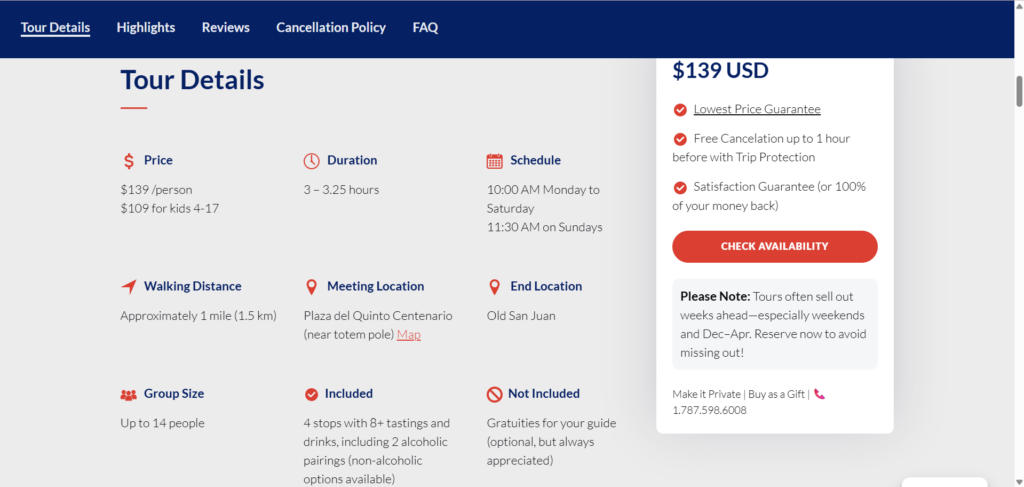
Price, duration, meeting point, end point, group size. All of this needs to be near the top of your page, no scrolling required. When visitors land on your page, they’re asking basic questions within the first three to five seconds. If they can’t find answers quickly, they bounce.
Look at how the Spoon Experience in Puerto Rico handles this. Everything you need to know is right there, clearly displayed, easy to read. No hunting required.
Photos Tell Your Story
Here’s a test: go count your photos right now. If you have fewer than 10 images on your sales page, you’re already behind. If most of those photos are landscapes or the backs of people’s heads, you’re missing the point entirely.
Half of your photos should show smiling guests and smiling guides. People book experiences based on how they imagine themselves feeling. When they see other guests genuinely enjoying themselves, that emotional connection does more selling than any paragraph of text ever could.
Features and Benefits Break Through the Noise
Most operators list features. You visit this landmark, you eat at that restaurant, you see these views. Fine. But that’s only half the equation.
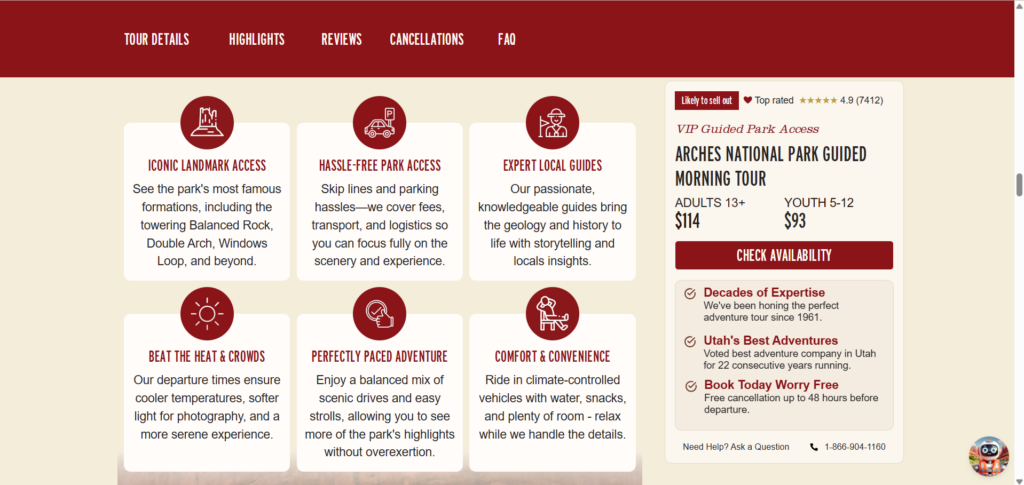
Benefits answer the question: why does this matter to me as a guest? Take an Arches National Park tour. The feature might be “early morning departure.” The benefit? Beat the heat and crowds, get softer light for photos, enjoy a more serene experience before the park gets busy.
This framework, repeated three to six times down your page, breaks up dense text while highlighting the most compelling reasons to choose your tour over someone else’s.
Credibility Indicators Build Trust
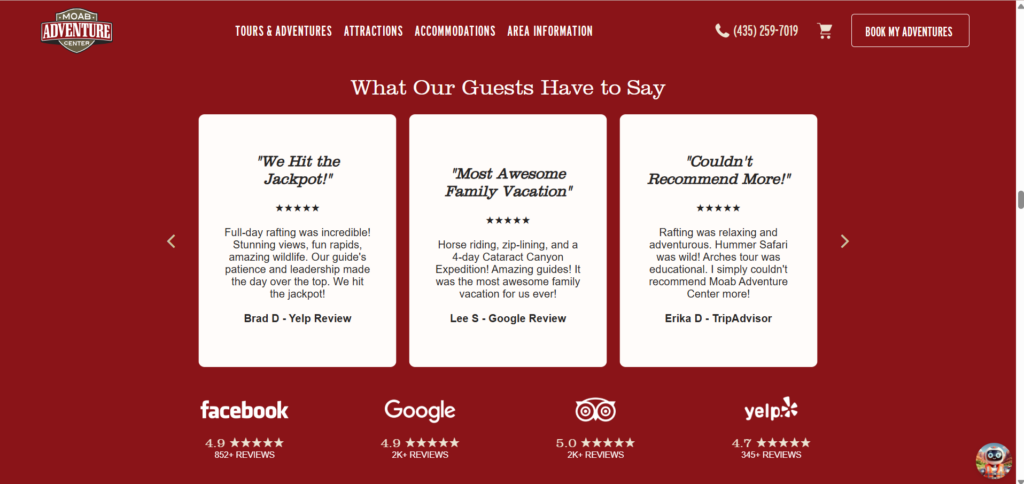
Media mentions. Awards. Years in business. Total number of happy guests served. Five-star review counts.
These elements signal legitimacy. The Moab Adventure Center does this well. They showcase their reputation across multiple review platforms, display their Best of State awards, highlight their Trip Advisor recognition, and note they’re an authorized concessioner. All of this builds trust before someone ever contacts them.
Testimonials Belong on the Sales Page Itself
If your testimonials live on a separate page that requires another click, they might as well not exist. Visitors need to see social proof right there, integrated into the flow of your sales page. Even a few testimonials make a measurable difference in conversion rates.
Your FAQ Section Is Doing More Work Than You Think
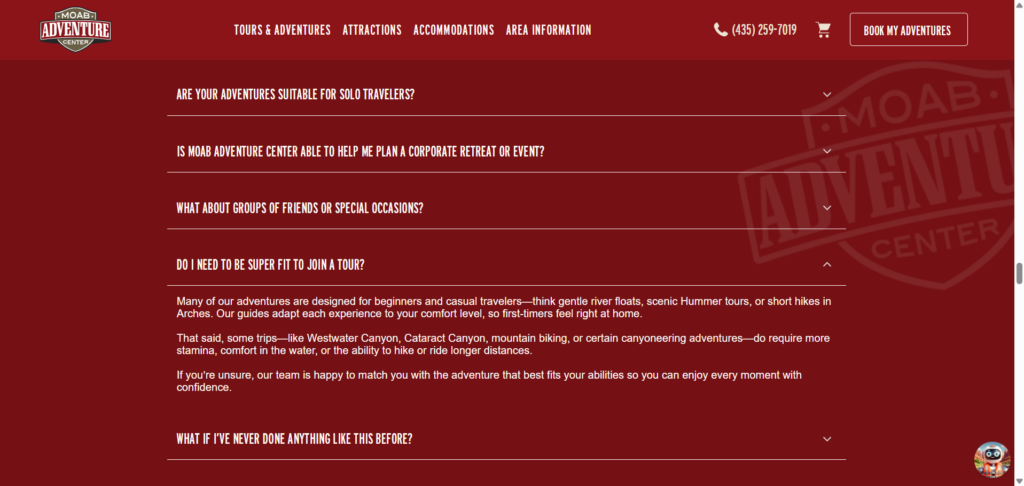
Fifteen questions. That’s the minimum. Your FAQ section isn’t just about answering practical questions like “What should I wear?” or “Is parking available?” It’s about overcoming objections and addressing hesitations.
Will this tour be too physically demanding for me? What if the weather is bad? Can I bring my kids? Is this tour worth the price?
Use an accordion-style format so it doesn’t feel overwhelming. Break questions into categories with clear titles. Make this section work for you 24/7 by anticipating and answering concerns before they become deal-breakers.
Your Call to Action Needs to Be Everywhere
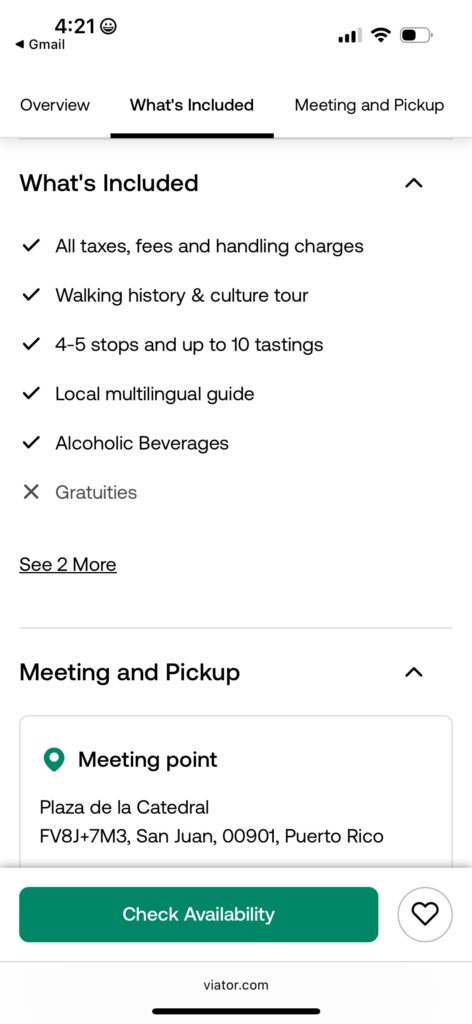
On desktop, as you scroll up and down your sales page, is your booking button always visible? On mobile, same question. If someone has to scroll back to the top to find your “Check Availability” or “Book Now” button, you’re adding unnecessary friction.
The Spoon Experience keeps their button visible at all times. Viator does the same on mobile views. There’s a reason: the whole point of your sales page is to get people to click that button. Make it effortlessly easy to find, no matter where they are on the page.
Urgency and Scarcity Drive Action
Limited spaces available. Peak season approaching. Tours often sell out weeks in advance. These aren’t manipulative tactics. They’re reality for most tour operators.
Call it out. The Spoon Experience notes that tours often sell out weeks ahead, especially on weekends and during high season. The Arches National Park tour reminds visitors that the park is hugely popular and morning tours sell out quickly.
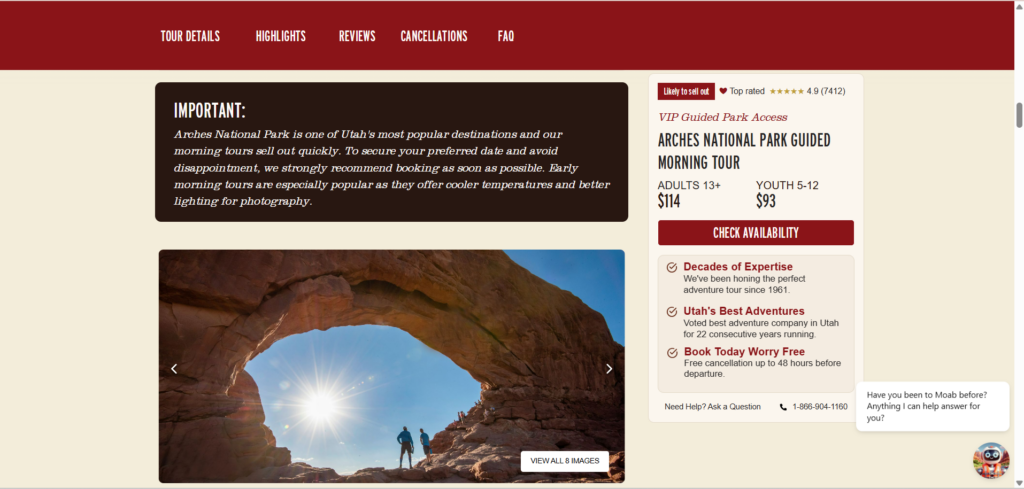
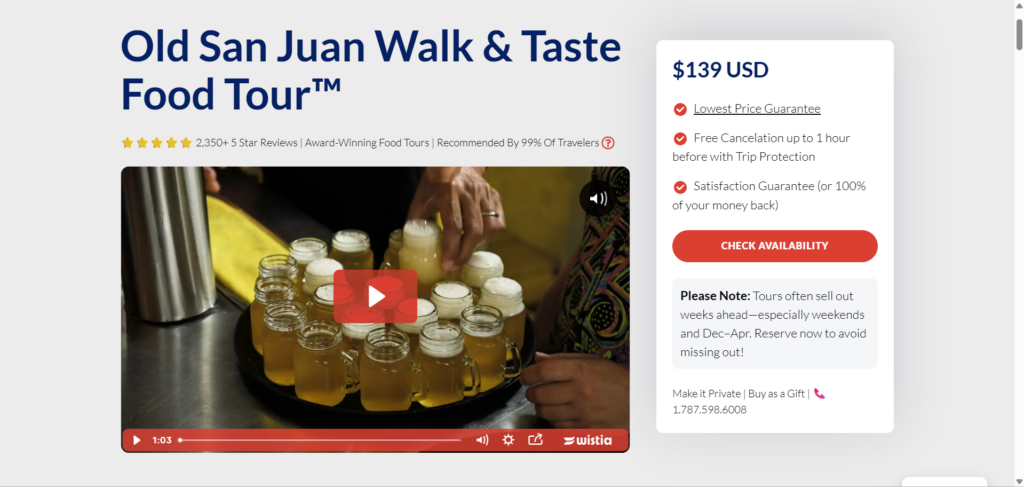
People need a reason to book now rather than later. If your tours genuinely do sell out or if availability is limited, say so clearly.
Where to Start
Audit your page against these 10 criteria. Be honest about what’s there and what’s not. Count your photos. Check if your call to action is always visible. Look for your credibility indicators. Review your FAQ section.
Give yourself a point for each element you have. If you’re scoring between eight and 10, you’re in good shape. If you’re below that, you’ve got clear opportunities to improve your conversion rate.
And remember: your sales page is one of the highest leverage things you can optimize in your tour business. Same traffic, same marketing costs, same operational expenses, but potentially 50% more revenue. That’s worth paying attention to.