


We don’t need complexity, but we do need simple best practices and awareness of common pitfalls. Here are four critical areas that will help you avoid the mistakes we see operators making every day and guide you toward foundations that will keep your multi-day tour business profitable for years to come.
Group Size Economics and Cost Buffers
Your group size directly impacts your profitability, but it varies by tour type. The general rule of thumb is straightforward: larger tours with more people are more profitable, while fewer people on the tour means you need to charge significantly more. Bottom line, you need to know your numbers using a cost plus calculator.
A budget-focused, multi-day tour through Mexico will have a significantly different cost profile than an African Safari. Calculate your break-even group size using that cost plus calculator, set your minimum break-even, then add one or two people at minimum to aim for your target profit margin. Always have a plan for what happens if you don’t reach your minimum.
Currency Risk Protection
Currency risk can destroy your margins if you’re not prepared. For any international departure, this becomes a critical consideration. If you’ve got 60% of your costs in a foreign currency, you might want a buffer somewhere between 5 to 8%. That’s actually a line item in your cost plus calculator—a buffer meaning that if currency fluctuates unfavorably, it won’t come out of your profits.
For unstable currencies or uncertain markets with increased volatility, we might want to increase that buffer to 8% or even 10%, depending on circumstances and volatility levels. We might also want higher buffers if we have longer booking windows—if you’re really booking out over 12 months, there’s higher risk associated with more time and volatility.
Lock in your supplier rates whenever possible and read the fine print on those contracts. Do you have written confirmation that rates won’t change due to currency fluctuations? Negotiate fixed rates to know exactly what you’ll be paying. Consider paying deposits in local currency to lock in exchange rates for major expenses, especially if you have cash on hand and want to secure a favorable rate.
If you lead trips consistently to areas with volatility and you’re nervous about passing a large buffer to price-sensitive customers, you could include a rider or clause with your guests. Make sure this is clearly communicated upfront—something like, “if we see currency fluctuations over 10%, there may need to be a supplementary fee.” This isn’t super common though. Typically, we build in a buffer that protects you and set trip minimums high enough that currency fluctuation doesn’t come out of your bottom line.
One of our coaching members faced this exact situation. Instead of going back to ask group members for more money, we developed creative solutions with additional upsells and packages before and after the trip with higher markups to help offset currency losses.
Single Occupancy Strategy
The industry norm recognizes that when a solo traveler books a double room, it often prevents you from having an additional person on the tour. That’s why we often charge a single supplement to help make up for those losses.
Here’s the simple economics: if you’re paying for double occupancy rooms regardless, single travelers should contribute meaningfully to help cover that cost. A smart single supplement strategy depends on demand for your departure.
For high-demand departures where you could easily fill that double room, charge as much as 50 to 75% as a supplemental charge. You can do this because there’s a bigger opportunity cost to sell to that single traveler. For lower demand departures or trips that aren’t selling rapidly, that single supplement might need to be lower—between 25 and 50% of the total trip price to encourage more bookings.
Always offer room sharing options for solo travelers who want to avoid the supplement and may want help being matched with another traveler.
The key insight many multi-day operators miss is that single supplements aren’t just based on cost, they’re also based on demand. We’re back to supply and demand principles. If you’re selling out, the smart business move is to increase the cost of accommodating someone traveling solo because you’re missing out on revenue. Higher demand means higher single supplements should be charged. Lower demand or when you want to encourage bookings means you can lower that supplemental fee.
Payment Timing and Cutoff Strategies
Your payment structure affects both cash flow and booking conversion. We highly recommend using deposits, often between 10 and 20% of the total trip price. This amount is enough to secure commitment but not so high that it prevents bookings or creates a difficult lump sum payment.
You need crystal clear payment terms and a final payment date, typically between 60 and 90 days before departure. This allows planning time while creating a window to capture last-minute bookings if needed.
A great best practice for developing sometimes complex pricing terms is examining not only your competitors but also companies you look up to or established multi-day operators. See how they present this information and their exact pricing terms. You can also leverage AI tools to take complex policies and distill them into client-friendly language.
Above all, payment terms should be easy for clients to understand. This helps you enforce them and helps clients avoid hesitations, concerns, or anxieties about what they’re committing to. Running payment terms through tools like ChatGPT, Claude, or Gemini can help create crystal-clear language.
Last-Minute Booking Flexibility
If you still have availability, you don’t necessarily have to close bookings at your final payment deadline. Accept last-minute bookings maybe up to two weeks before, but require full payment immediately. Consider charging a last-minute premium—an extra 10% to the published price for bookings within 30 days. You’re providing convenience, and last-minute travelers often have less price sensitivity.
For tours over $4,000 or $5,000, consider offering payment plans and different payment plan options. Booking software platforms dedicated to multi-day tours make this easy with two-pay, three-pay, or low monthly payment options.
Payment Plan Best Practices

Here’s an often-overlooked best practice: sometimes operators have deposits to secure bookings, but on tour sales pages, this information is hidden or missing entirely. We see big price tags of $5,500 for a trip, and it’s not until stage six or seven in checkout that people see they only need to put down $500 today. Put that deposit amount right where your full price is, so people understand it’s only this amount today to get started.
Give lots of different payment plan options, and call out that these are interest-free payments. Most of us collecting payments for purchases like this don’t charge interest on money not yet paid. Frame this as another perk: “If you don’t have all that money right now, don’t worry—we have interest-free payments to help you out.”
Consider incentivizing people willing to pay the full amount. Offer a couple hundred dollars off the trip or a 5% to 10% discount for full payment right away. Getting that money upfront means less administrative headache, that person is much more likely to be committed, and you can leverage that extra money to generate more demand and leads.
Minimum Group Size Policies
Understanding your minimum group size and cutoff dates is important internally for profitability and revenue—sometimes these are set by suppliers or accommodation providers. But we sometimes forget to clearly communicate this to clients, leads, and potential guests.
When a departure is guaranteed or when you’ve hit that minimum number, communicate that. More importantly, explain when and why trips might be canceled— not just for force majeure or political instability, but how your trip minimum policy works.
This might involve refunding people if you don’t have enough participants. But don’t forget better options: reschedule them or combine two trips together. If that’s not possible, consider offering private trip pricing.
We sometimes see situations where a family books a trip with a minimum of seven, then two people cancel. Instead of just canceling and refunding that family, explain the situation and give them options. We always encourage empowering clients to be involved in solutions. Offer to turn this into a private trip with a private premium so you can still run it on their preferred date. Other options include combining with another date, keeping trip credit, or receiving a refund. Involving them in decision-making is a great best practice.
All-Inclusive vs. À La Carte Pricing
If you’re running multi-day trips, you’ve probably encountered the decision of whether to be all-inclusive or have à la carte pricing for certain items. Across the industry, all-inclusive typically generates between 15 and 25% higher revenue per customer. Depending on your customers, they might prefer predictable pricing, and you can capture revenue on items they would buy anyway.
À la carte is more often used when appealing to budget travelers or offering significant flexibility. All-inclusive works when you want higher revenue per customer, simplified operations, and lends itself to more luxury positioning.
No matter what choice you make, be crystal clear on sales materials, trip pages, brochures, and detailed itineraries about what is and isn’t included: activity fees, entry costs, transportation to and from the trip start, gratuities, personal expenses, and whether alcohol is included.
The Value of “On Your Own” Elements
Here’s a best practice: have at least one “on your own” meal, even with group meals and all-inclusive pricing. Think of this not as cheaping out or making guests pay more, but creating opportunities for self-exploration and decreasing rigidity in your tour. It’s entirely appropriate, even with luxury or all-inclusive tours, to have elements like lunch or dinner where you encourage guests to create their own adventure. Be sure to set them up for success with recommendations, little maps, or restaurant guides.
Insurance and Force Majeure Considerations
Build protection into your policies more than your pricing. For force majeure, have clear terms about natural disasters, political unrest, and pandemic restrictions. Make sure this is crystal clear.
Recommend trip insurance. If customers purchase this on their own through recommended third-party travel insurance companies, you can often earn commission by providing links or recommendations.
Consider your own internal trip protection, distinct from third-party trip cancellation insurance. This is an individual upsell you control, where you might offer a more generous cancellation policy for an extra fee or percentage of trip cost. This essentially becomes profit that goes to you. It’s more complex in multi-day situations, but it’s possible.
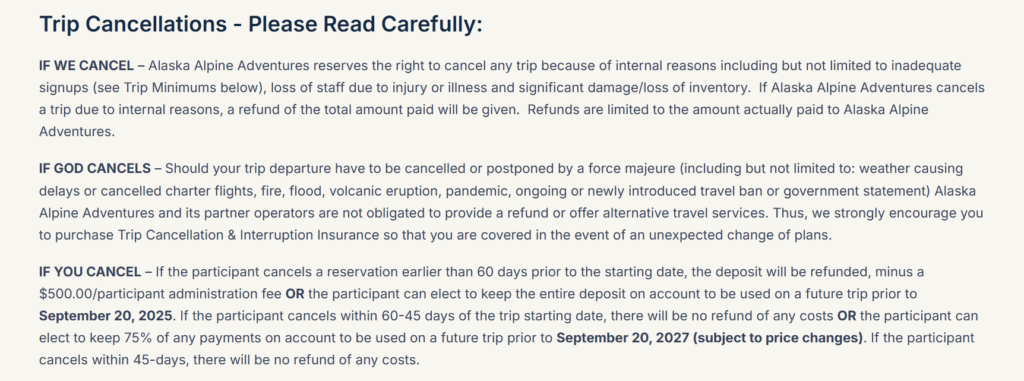
Clear communication is what’s important. Look at how Alaska Alpine Adventures breaks their cancellation policy down: “If we cancel, if God cancels, or if you cancel” with specific timeframes like 60 days out, 49 to 50 days out, or less than 45 days. It’s crystal clear.
Additional Best Practices
Offer fully refundable bookings within 24 hours. Let guests book with confidence and change their minds within 24 hours for a full refund—no stress, no risk.
Highlight transparent pricing and essentially a lowest price guarantee: “If you reserve directly with us, either online or by phone, we guarantee you’ll receive the best available rate. No need to shop around.”
Call out interest-free payment plan options: “Break up the cost without paying more. Reserve your trip now, spread out payments over time, 100% interest-free.”
Moving Forward
Multi-day tour pricing keeps many of the same fundamentals—it’s especially important to know variable and fixed costs. But by going through each of these topics, you should now have several best practices and know missteps to avoid. Make sure you’re building in the policies, protections, buffers, and minimums that will keep you profitable as a multi-day operator.
The difference between operators who thrive and those who constantly struggle often comes down to understanding these unique challenges and implementing the right systems from the start. Take the time to build these foundations properly, and you’ll have a multi-day business that remains profitable year after year.