
The reality? Multi-day tour bookings follow a completely different timeline than anything else in tourism. We’re talking about a six to 18-month window from first interest to actual deposit, and that changes everything about how you should approach marketing.
The Real Data Behind Multi-Day Bookings
According to industry research from Classic Vacations and TUI, multi-day tour bookings typically happen four to six months before departure, with some bookings made even earlier. But here’s the real twist: there’s also a surge in last-minute bookings that happens between 10 and 30 days out for domestic trips and around 30 days for international trips.
The booking timeline for multi-day tours is completely different from day tours, from hotels, and from other sectors in tourism. This extended timeline should inform every piece of marketing content you create.
Google’s Five Stages of Travel: Your Multi-Day Marketing Blueprint
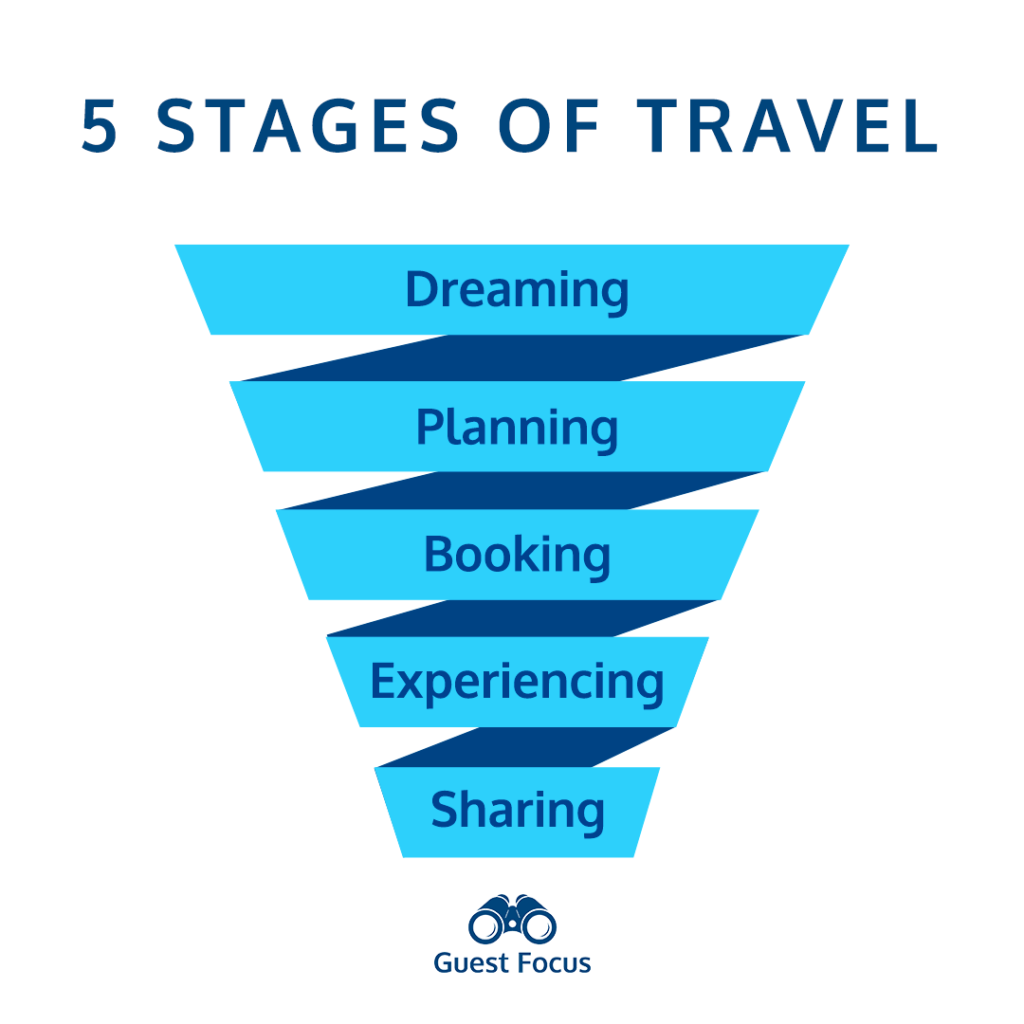
Understanding Google’s five stages of travel and how they integrate with our VIP Marketing Method™ explains exactly how multi-day bookings actually happen. These five stages—dreaming, planning, booking, experiencing, and sharing—form what we call the multi-day marketing funnel.
The reason we call this a marketing or sales funnel is that there are more people at the top in that dreaming phase than there are at the planning phase and ultimately the booking phase. So that’s why it’s in the shape of that funnel—lots of people dream and plan, but not everyone ultimately makes that booking.
The Dreaming Phase: 12-18 Months Out
The dreaming phase typically starts between 12 and 18 months out. Someone sees an Instagram post about Patagonia and thinks “someday I’d love to go there.” Your content here should be all about inspiration. This is where your visual marketing assets will truly shine—photos and images of spectacular destinations or off the beaten path places.
This is also an opportunity for you to position yourself as an authority on a particular destination or perhaps a particular type of travel. User-generated content and guest transformational experiences work incredibly well here, where travelers share content they captured with their own devices about how incredible their experience was.
The Planning Phase: 6-12 Months Out
Now they’re actively researching destinations, reading blog posts, and comparing different operators. They’re reading online reviews and customer testimonials, and they’re starting to engage with the many challenges that come with traveling – booking, planning, knowing where to go and what to do.
Your VIP marketing blueprint really shines here, where we have a great lay of the land in terms of their concerns, hesitations, objections, pain points, or even just dream scenarios they’re hoping to achieve. Educational content that addresses specific challenges works best—like what to pack in Iceland for winter, or fitness requirements for Patagonia trekking.
During this stage, you want tons of valuable content on your website and across your social media channels, so they’re spending more and more time with you and building that trust and rapport.
The Booking Phase: 3-6 Months Before Departure
This is when your ideal prospects have done their research and they’re ready to commit. At this phase, they’re probably doing their last due diligence—getting clarity on how making a booking actually works, payment terms, different options, and addressing any last-minute hesitations.
This is where your policies should be front and center, where you can collect their deposit and register them as smoothly as possible. Multi-day operators need to be on call to answer those last-minute questions and showcase social proof that’s going to nudge them over the edge.
Most importantly, in the booking phase, make it crystal clear what that last step is. Here’s how you do business with us. Here’s step by step how you get your deposit in. Here’s the exact link and place you go to do it.
Two Distinct Booking Patterns You Need to Serve
The market for multi-day tours is actually split into two distinct booking patterns that you need to appreciate. That traditional pattern we just described is still strong—families planning summer vacations, luxury travelers securing specific dates, adventure seekers who need time to prepare physically. These travelers often book those four to six months out, sometimes even longer.
But there’s a growing segment of last-minute bookers as well. These are people booking multi-day tours and making significant investments 10 to 30 days out. This includes remote workers with more flexibility, spontaneous travelers, and people filling last-minute schedule gaps.
Companies like Classic Vacations report serving both extremes: clients planning trips well into 2026 and beyond, alongside those making immediate travel arrangements.
What more established multi-day operators have figured out is that marketing needs to serve both segments. For early planners, create comprehensive destination guides, detailed preparation checklists, and early bird incentives. For last-minute bookers, focus on real-time availability, instant booking capabilities, and clearly communicate if you have space for departures just two or three weeks away.
The Content Creation Challenge
If you’re new to multi-day marketing, or perhaps you haven’t had a content marketing strategy where you’ve aimed to deliver value at each stage, you’re in a bit of a paradox. You need to create content for each stage of the traveler’s journey, and as much as possible, you want that to be evergreen.
In our coaching program, we recommend having eight core pieces of content for that dreaming phase that can be repurposed in lots of different ways, eight key pieces of content in the planning phase, and eight pieces of content for that booking phase. After one year, if you create one core piece of seed content every two weeks, you’re now in the enviable position of having marketing assets for each of those first three stages of the traveler’s journey.
Then you can leverage those different marketing assets depending on the indicators you get from your leads. On your trip sales page, if somebody raises their hand and says they’d like more information about this trip, that’s a behavior indicating that traveler is probably ready for some of your planning content.
Likewise, if you see repeat visits or inquiries, they might be getting closer to that booking phase. This is a great opportunity to retarget that visitor with booking phase content—clarifying how your cancellation policy works, sharing social proof, or adding any urgency or scarcity you can communicate.
Seasonal Variations and Predictable Patterns
Seasonal variations often create predictable patterns you can use to your advantage. If your destination or trips have a peak season, bookings often extend lead times even further. Someone booking a July Alaska cruise might start planning in November of the previous year.
Shoulder season bookings tend to have shorter lead times because there’s less competition for dates. If you see trends like this in your data, your marketing calendar should account for these patterns. That might mean starting to promote summer trips in January, not April, or beginning your shoulder season campaigns when people are finishing their peak season trips and already thinking about next year.
Creating Your Own Demand Patterns
One of the things we’re always reminding multi-day operators in our coaching program is that it’s up to you to create special offers and authentic urgency to create your own demand patterns.
Chelsea, who’s in our coaching program, builds a wonderful business taking American travelers to Central and South America. Every year when she’s releasing her new trip dates, Chelsea does a launch. She makes a big deal out of when she publishes those new trips, rewarding people on her mailing list or in her Facebook group with exclusive access and early bird discounts.
By doing so, she’s taken a relatively arbitrary date and created a huge booking surge every single year. Sometimes she can do between $250,000-$700,000 in sales in just 11 days because of that extra effort and emphasis on this special offer.
Using Your Payment Structure as Marketing Opportunities
Your payment structures and internal payment deadlines often reveal something important about booking behavior that most operators miss. If your final payment is typically due 60 to 90 days before departure, that gives you a natural deadline for creating urgency. But you can often accept bookings up to maybe even two or three weeks before departure with immediate full payment.
The strategic insight here is that your own payment structure creates natural marketing moments. Final payment deadlines, last-minute availability, premium pricing, or last-minute discounts all become marketing opportunities.
As an early bird discount expires or a final payment deadline approaches, increase the urgency with availability updates and departure reminders. Your booking behavior data from past years is a great place to start understanding these patterns.
Taking Action on Booking Timeline Intelligence
If you have booking data from your own customers in past years, that’s a great place to look. You can also use the industry data we’ve shared about these longer booking cycles and the typical journey reported from larger multi-day operators.
Leveraging that VIP marketing method, make sure you’ve got marketing content you can share at each stage of that traveler’s journey. In our full program, we have automations, examples, and tools you can set up to run on autopilot, or move someone from the slow lane to the fast lane when they’re ready to make a booking.
Finally, come up with special opportunities and offers—whether that ties into live events, online webinars, workshops, presentations to special interest groups, or special offers for particular partners. In addition to the natural urgency and scarcity that comes with any multi-day tour, you have a world of opportunity for creating your own urgency and getting those trips confirmed and bookings in as soon as possible.
The challenge is that this process can take months and months. Somebody might be inspired by your content in January but not make a decision about booking until June or July. While people’s attention spans are short, you need a presence as they move through all stages of travel. That’s really where the VIP Marketing Method™ comes into play – delivering value throughout the entire process while building trust and maintaining that pervasiveness across multiple channels where your ideal target guests are already spending their time.