How to create shared value in tourism, one tour at a time

The problem is that the “perfect” moment with more time and money never comes. Even if your tour company has extra money, you’ll want to use it to scale.
value

My typical conversation with a tour company used to go like this:

[me a.k.a. sustainability fighter] — You know, as a tourism industry we should be more sustainable and take more responsibility for our actions…

[a local tour company ] Yes, I totally agree! It’s just… not for me now. But as soon as I have more time, and more money, I’ll be do it. Promise!

I’ve been quite annoyed hearing it over and over. I couldn’t understand why someone wouldn’t want to be sustainable and responsible from the day 1. Then I understood that I’m the “captain planet” type of a person, and others want to make a living.
Look closer

The problem is that the “perfect” moment with more time and money never comes. Even if your tour company has extra money, you’ll want to use it to scale: hire more staff, produce better marketing materials, rent an office space. Anything that doesn’t directly contribute to a business’’ growth will always drop to the bottom of a priority list.

That’s why the traditional CSR (corporate social responsibility) approach doesn’t work for small and medium tour businesses. Most of CSR actions bring benefits to external organisations, and not for the business itself. Those that bring benefits, like PR-worthy fundraising campaigns and staff volunteering schemes, are out of their reach.

Very often, local businesses are inherently more sustainable and eco-friendly than the bigger ones because they are naturally closely connected to their communities, where people support one another. Also for most small tour provider, the tourist destination is their home, so they respect, care and love it more than almost anyone else.

But does it mean that being a local business in enough?

Aim higher

The sustainability bar in tourism is now higher than ever before.

On one hand, customers expect that you pay taxes, pay fair wages, don’t hire children, don’t harm animals, and that you generally are a responsible business. These are no-brainers, at least in the Western world.

Trends are also changing. Travellers, even the mass tourists, seek out local and authentic experiences. A few years ago taking tourists to a local restaurant would make you stand out but nowadays, using local in a tour description is nothing more than another marketing buzz-word.

On the other hand, over tourism is real. More and more destinations have troubles managing the influx of visitors. A small local tour business is part of the problem as much as any foreign travel company. The anti-tourism protesters would probably suggest that tourism businesses should close altogether. But what if this isn’t an answer?

The big question is then, so what’s next? If paying taxes is not enough, and CSR campaigns are not a solution, what does social and economical responsibility mean for a local tour company?

Social and economical responsibility of a local tour company should be measured by whether it creates win-win situations for all its stakeholders (shareholders, employees, customers, community, suppliers), or in other words — whether it creates a shared value.

“The principle of shared value involves creating economic value in a way that also creates value for society by addressing its needs and challenges. Businesses must connect company success with social progress. Shared value is not social responsibility, philanthropy or even sustainability but a new way of achieving economic success. It is not on the margin of what companies do but at the center.” (Creating a shared value, Harvard Business Review 2009)

Creating a shared value means creating economical and societal progress by innovating products, redefining supply chains and developing local clusters.

Hack it

In practice, it means that a tour business should be solving its major business challenges using solutions that also benefit the community it is part of.

And what are the key challenges an average tour business needs to solve?

  • How to sell more tours
  • How to sell tours for more $$
  • How to optimise tour operations to scale faster

These shouldn’t come as a surprise. A tour lies at the core of a tour operator’s business, and so it is the single most important determinant of its success. That’s why tour companies will always be looking for ways to design the most interesting routes, to attract, to train and retain the best guides, and to offer the best value for its customer’s dollar.

And the only way for a tour company to win both the profitability and social responsibility game is to find a way to solve these tasks through mutually beneficial partnerships with the local community.
But how?

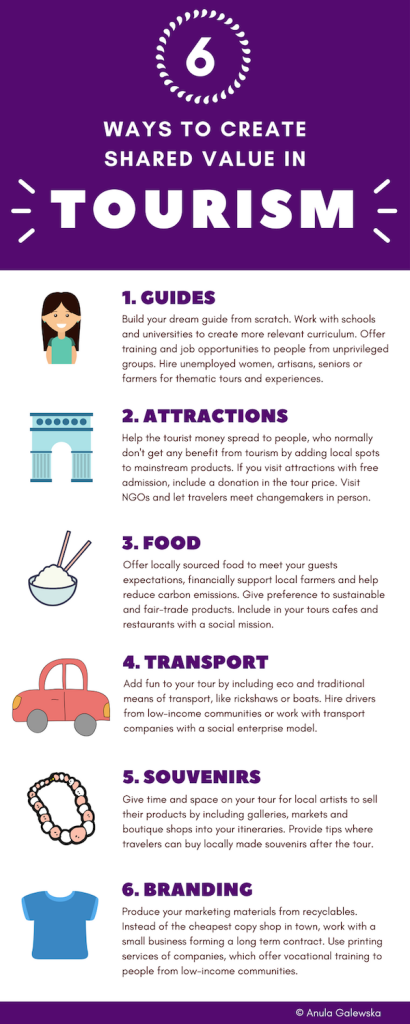
I have listed the 6 key components of an average tour, proposing a few solutions for each. You don’t need to go all in. Pick one, start small. Remember, you can make a difference one tour at a time.

1. Guides

A guide’s role can’t be overemphasized. A guide is a front (wo)man, storyteller, brand ambassador and salesman all in one. To enhance their importance, G Adventures calls guides the CEOs (Chief Experience Officers). Having competent, passionate, engaged, and most importantly, loyal guides is a dream of every tour company. Yet, finding a perfect guide is not easy. Those with high qualifications might be having high financial expectations. Those with wide previous experience might have a guiding style that doesn’t necessarily reflect your company’s values.

The International Labor Organisation is alarmed about the vast employment challenge. On one hand, the world needs more jobs for the millions of unemployed people, and on the other, businesses need skilled employees that are not so difficult to find. To meet this gap, businesses should work closely with schools and universities to create a more relevant curriculum. Hundreds of businesses and social enterprises around the world develop their own capacity building programs to find the right people.

There are a few great examples of this approach in the hospitality sector. Soria Moria Hotel in Siem Reap trains and hires locals from disadvantaged backgrounds through its educational and trainee programs. To empower ownership, Soria Moria employees are also its shareholders.

A few local tour and activity providers do a great job hiring and integrating unprivileged groups too. Migrantour is a European network promoting guided walks that are led by citizens from migrant backgrounds, designed to promote intercultural diversity. Unseen Tours (London) and Shades Tours (Vienna) are social enterprises that work with homeless and formerly homeless individuals, coaching them to lead city walking tours.

You don’t need to turn your business into a social enterprise. Collaborate with a local tourism school and co-create a training program for their students. The risk here is very low and the benefits are high. Not only will you get well-trained guides who understand your brand but you will also contribute to the increase of youth employability in your destination.

Think out of the box and look at different groups of people you can work with for your thematic tours and experiences. For example, you can engage unemployed women in cooking workshops, local artisans in handicraft workshops or heritage walks, farmers in village walks, or seniors to show travelers around their neighbourhoods (who else would know better what changes your city has been through than the people who’ve spent their whole lives there?).

2. Attractions

Places you visit make your tour stand out. A tour title and the key spots included in the route is usually what a customer will look at when making their decision to book. The brutal truth is that even the most conscious travellers will still want to see the most iconic landmarks, especially if they’re visiting a destination for the first time. And the tours which we, as locals, love the most, hardly ever sell. How to find a golden middle ground between niche and local, and sellable?

The trick is: combine the two. Attract customer’s attention with something well known, and sneak in something more insightful and local.

Once you get people on a tour, they will be more receptive. At the end, they will probably even mark the less touristy spot as a highlight of their tour. But without having a mainstream highlight, it will be much more difficult to catch their attention.

Use the same trick when packaging experiences — combine a mainstream product with a niche one, and be sure that both the tourist and the local economy will be satisfied.

By adding local spots you help the tourist money spread to people who normally don’t get any benefit from living in a touristy destination. It is important that you actually create space and time for tourists to spend money in these places. Include a food business and visit a local shop, gallery, or flea market.

If you visit attractions with free admission, let it be cultural centres, museums or churches, including a small donation in the tour price. This can be as little as 50 cents per person, or a few $$ per group but will make a difference in a long term. Even better, if a place sells souvenirs, you can buy them on behalf of a tourist and give it your guest as a surprise gift. Tourist will be thrilled, and the places you visit will be thankful too!

Another idea is to pay a visit to a local nonprofit organisation, that greatly contributes to a local community. Consider a project on ecology and green living, an organisation that helps unemployed women, immigrants, or any other initiative that is relevant to your destination. Tours that run in collaboration with NGOs gain popularity thanks to In Focus tours by Urban Adventures, Visit.org and Airbnb Social Impact Experiences.

3. Food

Who doesn’t want to try food that is fresh, delicious and local on their holiday? Offering locally sourced food on your tour not only will meet your guests’ expectations but will also financially support local farmers and help reduce carbon emissions.

Sometimes I hear an argument that tourists don’t want to eat the same thing over and over or that you can’t only serve traditional food in a multi-cultural destination. Who said you should?

Be creative! Encourage restaurants to come up with local fusion menus and astonish tourists with new flavours. If you want to show international influences, find vendors who prepare their foreign dishes with local products like the guys from my neighbourhood, Woodie’s Kitchen — Italian pizza made with local Canarian products from a local market.

Say no to unethical meat produce and unsustainable fishing, and don’t be afraid of your customers’ reaction. In an interview with Pat Dwyer, former Global head of CSR & Sustainability at Shangri-La, she explained that banning shark fin in the menus (a big thing in Asia) was the most creative moment for chefs because instead of serving the same dish over and over, they could bring their own ideas to the plate. And guess what, customers not only did not complain but they totally loved the new menus!

It’s not only about what food is served but also who serves it. When searching for cafes and restaurants to work with, look for locally-owned small businesses, which normally don’t get a chance to work with large clients.

You can go a step further and incorporate social enterprises into your route, offering vocational training and job opportunities to unprivileged groups. Such initiatives can be easily found in most of mid-size to big cities. Refugio Café in Berlin offers training and work for refugees, Myrtillo Café in Athens gives job opportunities to young vulnerable people, Crisis Café in London offers training and employment to homeless people, and the list goes on an on.

Another group of places worth adding to your route are cafes and restaurants that let you purchase food or drink for someone less fortunate. Prague’s Lokál, anyone can buy lunch for a homeless person.

One more thing you can do to support local food producers and restaurant owners is simply to provide a list of recommended places to eat and drink for after the tour. If you make a short list and send it to your guests after the tour, they will be more than happy!

4. Transport

If your tour includes moving people from one place to another, you will have to hire drivers or transportation companies. By choosing your suppliers wisely, you can make a positive impact on the local community.

Try to integrate eco-friendly and traditional means of transport as part of your tours, for example, rickshaws or boats. You will add a fun element to your tour, offer more jobs to locals, and keep the environment clean, all in one go!

If you own vehicles, hire drivers from low-income communities. Intrepid Travel works with female drivers and tour leaders in Africa and leads the way to female empowerment in the region.

If you don’t own vehicles, as a rule of a thumb, work with locally-owned businesses. You can also look for co-operatives that support micro-entrepreneurs. My favorite example is Sakha Cabs, a social enterprise from Delhi, which exclusively employs female drivers from marginalized and resource-poor communities.

If you don’t have transport included in your tour, you can still promote local drivers. Create an informal network of low-income drivers and encourage your guests to use them for private and independent excursions.

5. Souvenirs

Souvenirs are an important part of every holiday. According to Holiday Inn Souvenir Study, only 1/5 of holidaymakers come back home empty-handed. The same study reveals that over 40% of travelers would look for souvenirs in a local market. Some take the search to a next level and go on full shopping tours. Because who else knows best where to find a local, authentic souvenir?

This is a perfect opportunity for you to support local artists and craftsmen. Very often these people don’t have business skills or tools to reach tourists directly, so you promoting them to travelers will make a big difference.

Give time and space on your tour for local artists to sell their products. In restored railway stations across Ecuador, Tren Ecuador, created Artisan Squares, which are dedicated spaces for local artisans to showcase and sell their creations to tourists and locals.

Also, Urban Adventures teamed up with talented artisans from all over the world to run Made In shopping tours, which form a different type of shopping experience that brings authentic urban craftsmanship to life by leading a traveler on a journey into local lives.

If you know artists who work with recyclable waste, you can bring them paper waste or plastic bottles that they could turn into beautiful gifts for your customers. A workshop like jewellery making from recycled materials is a great activity that you can easily include in one of your itineraries.

Your role as a tour company is to help your guests get the most out of their stay in your destination. Along with your list of local restaurants, provide tips where travelers can buy locally made souvenirs after the tour.

6. Branding

A cherry on the top of every tour is your branding. Branded t-shirts, gadgets, maps and handouts. You probably use at least one of those. Where do you get these materials from? You can also make a difference here by selecting your suppliers wisely.

Can your marketing materials be printed with recyclables? Do you print your materials in the cheapest copy shop in town, or do you work with one business owner and support him and his family for years? Is there maybe a social enterprise around the corner, which offers printing services, and also hires people from unprivileged groups?

* * *

The bottom line is: think out of the box. Whenever you search for employees and suppliers for your amazing tours, look around and find ways not only to help yourself but help others too. Creating a shared value is when everyone wins, and you can start today, one tour at a time.

* If you have more ideas and know other examples of how local tour providers create shared value, let us know in your comments below!

Inspiration and lots of information used in this article was taken from “Creating a shared value” (Harvard Business Review, 2009) and “Destination Mutual Benefit. A Guide to Inclusive Business in Tourism” by GIZ and Endeva.
A GUEST FOCUSED APPROACH: LEARN FROM THE EXPERTS

Get the newest tour guide resources: advice, guides, and news on the tours, activities, and attractions industry from a Guest Focus perspective.

GET OUR NEWSLETTER

Avital Ungar is the founder and owner of Avital Food & Drink Experiences, a culinary company that hosts in-person and virtual events for corporate team building, client entertainment, and conferences. Her mission centers on deepening human connection through storytelling, food, and drink.
Ungar’s passion for the finer points of life began while living in Paris and the quaint town of Aix-en-Provence in Southern France, where she embraced the cultural norm of afternoon wine and explored the countryside’s culinary offerings. Upon returning to the United States, she pursued formal wine education and is now a certified sommelier.
A Phi Beta Kappa UCLA graduate, Ungar studied Art History, French, and Mandarin Chinese, though she jokes she wishes she could have majored in Chocolate. After living in Shanghai and working in the Chinese Contemporary art market, she returned to her hometown of San Francisco to pursue her professional interests in art and food.
Since April 2011, Ungar has operated Avital Food & Drink Experiences, offering progressive dining food tours in San Francisco, Los Angeles, and New York City, where each course is served at a different restaurant. The company also provides dining experiences, conference activations, and interactive meals in 12 cities nationwide. Her virtual offerings include culinary experiences with ingredient delivery featuring award-winning chefs, bartenders, and sommeliers, along with virtual mixology classes, cooking classes, water tastings, and aperitif hours.
In September 2022, Ungar launched Edible Architecture, which creates innovative holiday products including Charcuterie Chalet Kits – savory gingerbread houses made from charcuterie and cheese board items, complete with “Salami Shingles” and “Parmesan Snow.”
Ungar has been featured in The New York Times, served as a judge at the Good Food Awards, International Chocolate Salon, and Best of The West Rib Competition, and has appeared on the Travel Channel, CNN, and in USA Today.
Midgi is the owner and Chief Eating Officer for Juneau Food Tours and Taste Alaska! She has lived in Alaska for more than a dozen years and got her start in the culinary industry as a food writer and blogger. Her tour company opened in 2014 and has hosted thousands of hungry visitors in Alaska’s capital city. In spring 2020, Midgi launched Taste Alaska!, a subscription box service to ship shelf-stable Alaskan food gift boxes.
The pandemic also presented the opportunity to create www.globaltoursconnect.com, an online boutique marketplace for food, history, and cultural tours.
Her passion for food and telling the story of Alaska have been noted in the New York Times, Washington Times, Washington Post, Vogue.com, Forbes.com, AARP, as well as countless blogs and international and national television shows, including All the Best with Zita and Gordon Ramsey: Uncharted.
Gez Hamer is an entrepreneurial leader with extensive experience building and scaling businesses from startup to growth phases. He possesses strong strategic decision-making abilities and hands-on leadership skills, with experience across startups securing Series A investment, scale-ups obtaining continued funding, and post-acquisition companies ranging from SMEs to publicly listed global players.
Since June 2025, Hamer has owned Nautica Collective, a company reshaping luxury yacht travel for the new generation of travelers. Nautica Collective offers curated, boutique yacht experiences designed for over-30s millennials seeking connection, culture, and comfort through small groups, hidden anchorages, and chef-hosted dinners under the stars. The company operates routes in Mallorca, Greece, the Caribbean, and beyond, positioning itself as “aspiring luxury meets authentic adventure.”
In January 2025, Hamer co-founded Transcend Consultancy, which helps businesses navigate growth challenges with cost-effective solutions. The consultancy works with founders to streamline operations and expand into new markets, specializing in the transition from startup to scale-up with strategies built for today’s fast-changing business landscape.
Previously, Hamer served as Chief Operating Officer at ExperienceFirst from November 2022 to December 2024, Interim Chief Commercial Officer at Bundl from July to November 2022, and CEO/Management Consultant at GJH Consulting from October 2016 to November 2022. His diverse background spans consulting, operations, and commercial leadership across multiple industries and business stages.
Akila McConnell is a dynamic entrepreneur and cultural historian who owns Unexpected Virtual Tours and Training, and Unexpected Atlanta Tours & Gifts. She creates radically creative cultural training sessions for remote teams and immersive tours for visitors to Atlanta.
Since 2020, her virtual tours company has been featured in The New York Times and Forbes, specializing in cultural awareness events around Juneteenth, Hispanic/Latinx Heritage Month, and Pride. Her Atlanta tours business, operating since 2015, has been named one of Conde Nast’s 16 best things to do in Atlanta and National Geographic’s top tour in the city.
As a freelance culinary historian and writer since 2009, McConnell contributes to major publications including Conde Nast Traveler, USA Today, and National Geographic Traveller. Her book “A Culinary History of Atlanta” was a finalist for Georgia Author of the Year in History in 2020. She also hosts “Savory Stories,” a food-focused podcast on WABE, Atlanta’s NPR affiliate.
McConnell specializes in sharing stories of disenfranchised and minority populations through food, history, and immersive experiences that challenge the perception that cultural education has to be boring.
A Colorado native, Staci left a job she loved designing dental offices and funeral homes, to accompany her husband on a job transfer to the Central Coast of California in 2009. At the height of the Great Recession, jobs in an area known for its high density of retirees – let alone jobs in her industry – were scarce to non-existent.
After a couple unsuccessful years trying to resurrect her thriving career, someone mentioned a Food Tour. In a few short months she researched, built, and launched Carmel Food Tours (CFT). Now in its 12th season, CFT is expanding and rebranding to Enjoy Carmel, offering more than just food tours. CFT employs 6 guides, and plans to grow the staff by 50% in 2023.
In her free time she enjoys traveling, pickleball, and Pilates with her husband, and tossing a tiny ball at the beach for her fluffball Chuck.
Simon began his career in tourism as a tour guide with Fat Tire Tours – Paris. As a trained social studies teacher and a dual FR/US citizen, this job fits like a glove! After three years as a tour guide with Fat Tire and side-hustling as an independent motorcycle guide, Simon returned to FTT – Paris to create its human resources department.
Specializing in local compliance and talent acquisition, Simon took over the hiring strategy for FTT’s European operations in autumn of 2019. With a new group of trainees set to begin work in several cities, COVID required an immediate 180 degree turn for everyone. After a decade of building tour leader teams, Simon combined his two passions and started a motorcycle sidecar tour business, and welcomed his first guests in Paris in spring of 2022.
Born and raised in Charleston, SC, Catherine began her 18-year career in tourism waiting tables while in college at one of Charleston’s busiest restaurants. What started as just a fun job that paid the bills and allowed for many social outings with friends, had turned into something that made her realize that working in hospitality was the only industry she ever wanted to be in.
After graduating from the College of Charleston, she came to work at Bulldog Tours in 2007. Serving as Operations Manager, Catherine oversees a staff of 50+ tour guides and customer service members. The best part of the job for her is seeing guests experience and love Charleston in the same way the staff does. When she’s not working, she enjoys playing volleyball, going to the beach and spending time with her husband and two super adorable daughters.
Chad is an experienced tour leader, trainer and tour business consultant. He’s been the go-to-guy for developing world-class training programs and leading global teams for tour operators such as G Adventures and many small to medium tour and activity businesses. Chad also comes from a background of startups in the tech industry, having worked for Adventure.com, Airbnb Experiences and other great companies.
Live the life you dream of living… That’s Chad’s mantra and he does his best to bring it to life every single day. Chad’s a big fan of micro adventures and spending quality time in the wilderness, sailing, hiking and camping with his wife Julia, daughter Cali and friends.
John founded Bulldog Tours in 2001 as a hobby with a goal of helping preserve his hometown. This sustainable tourism model has raised over $4M to help preserve many of Charleston’s most historical landmarks. Bulldog Tours offers a variety of history, food, pub and ghost walking tours with over 50 tour guides.
John is the Chairman of the Charleston Area CVB’s Travel Council and on the Advisory Board for the College of Charleston’s Hospitality Tourism Management Department.
Ralph Velasco is the founder of Continental DRIFTER® Experiences, where he has developed more than 200 once-in-a-lifetime travel experiences since 2008. He specializes in travel product development, researching and vetting local partners in destinations worldwide, conducting scouting trips with local operators, and creating unique itineraries that guests remember for a lifetime.
Velasco has personally led small group tours (4-10 participants) to more than 30 destinations including Antarctica, Spain, Portugal, Italy, France, Cambodia, Lapland, Vietnam, India, Bhutan, Romania, Mexico, Morocco, Turkey, Iceland, the Baltics, and the Adriatic. As founder of Continental DRIFTER®, he handles every aspect of the business from branding and trip design to marketing, social media management, contract negotiations, and client follow-up.
Since December 2018, Velasco has expanded his expertise through The Continental DRIFTER® YouTube channel, which features more than 75 videos offering travel advice, photography tips, destination guides, and interviews with locals. The channel targets GenX and Baby Boomer travelers and serves as the hub for his international tours. He conceives and films all content, oversees channel branding and optimization, writes scripts, records voiceovers, and manages social media distribution to increase viewer engagement.
Through his comprehensive approach to travel experiences and content creation, Velasco combines his extensive international travel expertise with practical advice for mature travelers seeking authentic, well-curated adventures.
Yaron’s love for travel turned into an 18-year career building one of Israel’s most successful travel companies. What started as personal wanderlust became Abraham Tours and Hostels – a business he co-founded and grew from scratch into a powerhouse serving 100,000 travelers annually.
As CEO from 2010 to 2022, Yaron learned how to turn great experiences into profitable business. The early years weren’t profitable despite rave reviews – they focused on creating amazing content without understanding business fundamentals. Once they cracked variable pricing, team management, and operational efficiency, everything changed.
Yaron and his team built systems that let him step away from answering every email. He developed bonus schemes that kept their best guides and drivers loyal for years, reducing industry turnover. Most importantly, he learned how to scale across multiple destinations while maintaining quality and profitability.
After stepping down as CEO in 2022, Yaron spent eight months traveling before launching his consulting practice. Now he works with the Israeli National Parks Authority on major system overhauls and helps tour operators worldwide through Guest Focus coaching, as well as other consulting projects.
Yaron brings this scaling experience to operators ready to grow beyond the one-person show, helping them delegate, systematize, and make data-driven decisions that improve both profits and personal freedom.

Accomplishments:

  • Co-founded and grew Abraham Tours & Hostels from startup to serving 100,000 tour participants and 200,000 hostel guests annually

  • CEO from 2010-2022, scaled company to 4 hostel locations plus a multi-destination tour operations

  • Established Israeli Hostel Association 17 years ago, served as general manager and chairman

  • Developed variable pricing schemes and team management for 100+ subcontractors/guides

  • Successfully exited as CEO in 2022, now consulting & mentoring various businesses in Israel and globally

After receiving his Applied Degree in Ecotourism & Outdoor Leadership from Mount Royal University in Alberta, Canada, Dave Kratt has made a living for the past 20 years in the alternative tourism industries as a guide, researcher, instructor, teacher, facilitator, manager, business owner, and naturalist. He has worked in many world regions including Central America, Australasia, Asia, and North America, applying his skills and training to various tourism, cultural, and environmental initiatives.
Kratt has been fortunate to find success through starting a number of businesses, which he tailors to achieve a more personal work/life balance. Recently, he made the significant decision to sell his farm and offload all personal and business assets, relocating his family (wife, daughter, and two dogs) to be more present in aiding his aging parents. This transition has provided him with the opportunity to share his business expertise through new and exciting channels.
In addition to his regular business coaching role with Guest Focus, Kratt recently started a consulting business called Wild Kratt Tourism Consulting Ltd. The two operations complement each other and have helped him find ways to share his passions for recreation, tourism, travel, and nature while enabling others to engage in these activities safely and consciously toward their potential social, economic, and environmental impacts.
Klaudija packed her bags in Slovenia 20 years ago with no plan except to see the world. A travel rep job in Turkey was supposed to be temporary – just long enough to fund the next adventure. Instead, it launched a global career building tour businesses from nothing and selling them for profit.
Her biggest win came with Urban Adventures, joining when it was just an idea without a brand. Over 10 years, she helped grow it to 500,000 passengers working with 170 tour operators worldwide. She spearheaded expansion into experiential products and negotiated one of the industry’s first media partnerships with New York Times Journeys.
Klaudija also built and sold two tour businesses in Ljubljana and London. Not many coaches have walked the startup-to-exit path.
Now she’s Head of City Experiences at TUI, leading an experimental department testing new products. This year her team achieved 75% revenue growth and 50% growth in passenger numbers.
Klaudija brings startup grit and corporate scale to Guest Focus coaching. She specializes in sales strategy, marketing optimization, and distribution channels. Her coaching clients particularly value her website development expertise – she’s guided three members through complete overhauls.

Accomplishments:

  • Grew Urban Adventures to 500,000 passengers working with 170 tour operators worldwide over 10 years
  • Negotiated one of industry’s first media partnerships with New York Times Journeys
  • Built and sold two tour operating businesses in Ljubljana and London
  • As Head of City Experiences at TUI: achieved 75% revenue growth and 50% passenger growth in one year
  • 20 years in travel industry across multiple roles: rep, guide, marketing, sales, managing director

Angela Shen is a proven business builder with deep roots in entrepreneurship and brand management.

Angela founded Savor Seattle in 2007 and grew it to a $1M business in under 5 years without outside investment. During the COVID shutdown in 2020, she pivoted the business from food tours to curated food boxes and grew revenues more than 2x her best tour year! Angela was named in Puget Sound Business Journal’s Top 40 Under 40, and started a second tour business Savor the Wild Tours in 2023.

Angela’s expertise in business strategy and operations hails from the consumer packaged goods sector where she previously worked in brand management at PepsiCo and looked after iconic brands including Quaker Oatmeal and Life Cereal. Angela is a graduate of the Wharton School of Business and serves on the board for Visit Seattle.

Ana stumbled into tourism backwards in the 1990s—first as a guide in remote Northwest Argentina mostly because she spoke English where few others did. As a horse rider, mountaineer, and fitness trainer, she naturally fell into adventure guiding, learning the hard way by doing first and studying later.

Everything began to click when she attended her first ATTA Adventure Travel Trade Summit in 2014. Suddenly, the entire structure of the travel industry made sense—the difference between operators and travel advisors, how B2B relationships actually work, or how marketing for a B2C audience is so different. That clarity saved her years of trial and error.

Since then, Ana has built her own travel company, Adentrando, initially as an active inbound tour operator for Northwest Argentina serving multi-day B2B clients, and since 2023 as an Argentina DMC and also operating trips in Latin America, working together with trusted partners. She’s become an ATTA trainer, developed Adventure Travel Guide Standards, and spoken at major industry events about responsible tourism and community partnerships.

Ana brings her hard-earned industry knowledge to Guest Focus members, particularly those starting out or pivoting their business models. Her specialty is multi-day trip design—creating itineraries that tell a story and have a positive impact, rather than just connecting attractions. She helps operators avoid the mistakes that cost her years of learning, turning complex industry relationships into clear, actionable strategies.

Accomplishments

  • First woman adventure travel guide in Northwest Argentina, driving Land Rovers across deserts
  • Been an ATTA trainer since 2016, traveling to Jordan, Chile, Colombia working with suppliers
  • Co-creator of Adventure Travel Guide Standards (2015) – one of 15 people who developed industry standards
  • ATTA business partner since 2012 and trainer for their Adventure EDU program
  • Speaker at major industry events like Pure, Lata in London, ATTA World Summit, Adventure Elevate on responsible tourism and adventure travel product design.

Casey spent 14 years at Zegrahm Expeditions, climbing to VP of Marketing Communications where she managed a million-dollar budget. Through her leadership, Zegrahm increased business with travel advisors by 10% and cut direct mail costs by 23% – real money when working with those numbers.

After Zegrahm, she spent a decade at the Adventure Travel Trade Association (ATTA), growing net revenue by 30% and profit margins by 60%. Through COVID and its recovery, as President of the ATTA maintained a 90% team retention rate by keeping people engaged and motivated.

Now running Casey Hanisko Coaching and Consulting in Seattle, she’s doubled her own revenue in one year while becoming ACC certified through the International Coaching Federation. She’s also Dare to Lead and DISC and EQI assessment certified, bringing structured tools to her approach.

Casey specializes in strategic planning and getting tour operators out of the daily grind so they can work on their business instead of in it. She helps solo entrepreneurs and small teams document knowledge, define roles, and build growth systems. Her Guest Focus clients have hit major milestones – one reached a million in revenue, others doubled income, and several Guest Focus members have brought on new team members, consultants, and partners.

She’s passionate about supporting women leaders and purpose-driven operators focused on responsible tourism.

Accomplishments:

  • Grew ATTA net revenue by 30% and net profit margins by 60%
  • Maintained 90% team retention rate during COVID challenges
  • At Zegrahm Expeditions: managed million-dollar marketing budget, increased travel advisor business by 10%
  • Cut direct mail costs by 23% (significant savings on million-dollar budget)

Jess quit her high school teaching job for what she thought would be one fun summer guiding bike tours around Paris. Eleven years later, she’s still there. Turns out, trading lesson plans for tour routes was the best career move she never planned to make.

She worked her way up from tour guide to director at Fat Tire Tours, learning every role – designing tours, training guides, managing ticketing, overseeing operations. This ground-up experience taught her what works for staff. She now works as Europe Head of Retail, as well as overseeing Paris/Versailles operations.

Her biggest win? Maximizing operational efficiency while keeping the human element intact. She redesigned scheduling systems to reduce labor costs and spoilage, automated data processes, and streamlined operations without losing Fat Tire’s family-friendly culture.

What she’s most proud of is her team development approach. Using her teaching background, she focuses on staff satisfaction and growth, helping guides and managers build confidence. Many told her the training changed not just their work performance, but their lives outside the company.

Jess brings this dual focus – operational efficiency plus people development – to Guest Focus coaching. She works with operators from solo startups to multi-million dollar companies, helping them increase profitability while maintaining authentic culture. Her coaching clients especially appreciate her reminder to take breaks and prioritize self-care.

Accomplishments:

  • Worked way up from tour guide to director at Fat Tire Tours over 11 years
  • Maximized operational efficiency – redesigned scheduling systems to reduce labor costs and spoilage
  • Automated data entry processes and streamlined operations without losing company culture
  • Developed team management systems with 60+ guides, created buddy system and quarterly reviews
  • Created staff retention program with traditions, events, and ‘dominate’ t-shirt recognition system

Fieldbook focuses on one thing: simplifying all the behind-the-scenes work that goes into delivering a tour.

The Fieldbook platform makes it easy to:

  • Publish stunning, interactive itineraries digital and paper itineraries
  • Equip guides with a comprehensive run-sheet
  • Streamline supplier management and track reservations and rooming lists
  • Bring all your tours into one connected workspace

Unlike other platforms, Fieldbook is simple and easy to use. And because it’s a small business just like you, you’ll get the kind of support big software companies can’t offer. That means getting up and running in days, not weeks.

If you want to give Fieldbook a try for your next tour, you can sign up here or if you want to have a chat feel free to reach out to me directly at [email protected].

More About Fieldbook

ResmarkWeb delivers results for tour operators.
When All Ways Adventures had zero bookings on July 4th, they knew something had to change.
That’s when they partnered with ResmarkWeb – a digital marketing agency that specializes in the tour industry.

ResmarkWeb’s solution delivered:
– 30% revenue growth this season
– Higher search rankings for qualified traffic
– A website that converts visitors to bookings
– Responsive ongoing support (changes happen with just an email)

What sets ResmarkWeb apart? They understand tour operators. Their team walks you through every step, from understanding your vision to optimizing for conversions.

Nathan’s takeaway: “Don’t wait until you’re burned out. ResmarkWeb helped us grow without compromising our values.”

More About ResmarkWeb