
Here’s what we mean by bottom-of-funnel marketing and why it matters so much for multi-day operators.
Understanding the Travel Booking Funnel
We leverage the travel booking funnel first pioneered by Google, which has five stages in the traveler’s journey: dreaming, planning, booking, experiencing, and sharing. The funnel shape exists because at the top in that dreaming phase, there are more prospects. Fewer people move forward to start planning that trip, and even fewer make it to the booking phase.
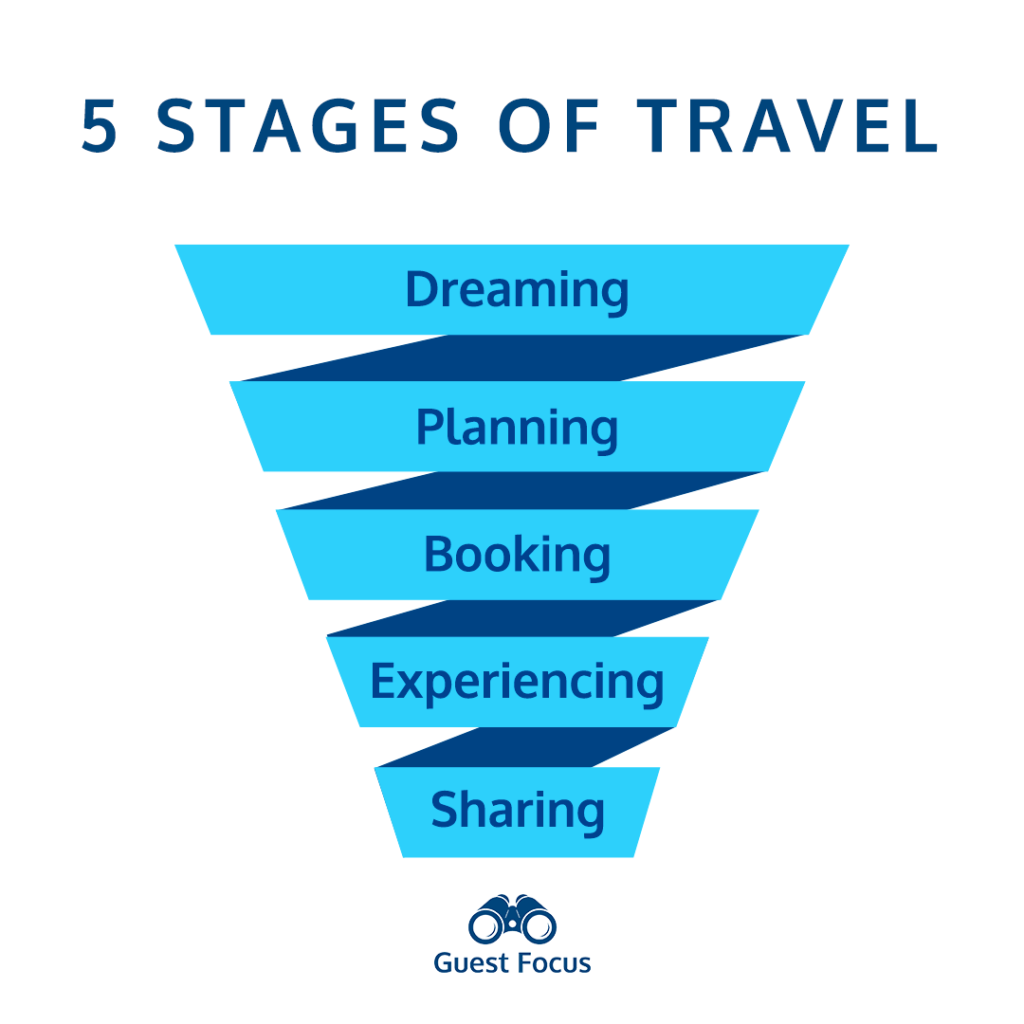
When we talk about bottom-of-funnel, we’re focusing on that booking phase. These are people who have shown the most interest and are furthest along in their journey. They may have chosen a destination, a type of travel, maybe even a time of year. Now they’re deciding who to go with, how to book it, researching different companies, and probably reading lots of reviews.
The great news about bottom-of-funnel marketing is that it has a higher conversion rate because you’re targeting warm prospects who’ve already shown interest. Multi-day bookings have long consideration periods, sometimes booking months in advance, often taking a long time to make the decision to put down a deposit. This means you’re likely to get a higher return on marketing efforts when you target this bottom-of-funnel.
But here’s the challenge: most multi-day operators don’t know who their warmest leads are.
The Detailed Itinerary Strategy
You might have great sales pages following all the best practices, but you don’t know who those folks are coming to those sales pages. Are certain people visiting multiple times? There’s no way to track indicators of interest.
Here’s where we want to introduce one of our best practices for multi-day operators: We highly recommend having a more detailed itinerary or expedition guide for each trip, and withholding that behind an email capture—ideally an email and phone number capture where the phone number is optional.
Let’s look at some real examples of how this works in practice.
Western River Expeditions, a well-run and established adventure and rafting company, uses this strategy on their Utah rafting Cataract Canyon classic tour. They have a great sales page, but notice they include a “download guide” option. When you scroll down, you see “request your complimentary expedition guide.” These comprehensive PDF guides include river maps, overview, full itineraries, camping and weather information, details on physical requirements, packing lists and more. The only way to get this detailed expedition guide is by providing your email and additional information.
We see this best practice across the industry, especially with larger multi-day operators. Backroads, one of the largest active travel adventure companies, uses the same approach. On their sales pages, if you want to learn more about a trip, you can “request a detailed itinerary, complete with descriptions of each day, tips on travel arrangements, regional highlights and more.”
Real-World Implementation
Dan and his team at Alaska Alpine Adventures joined our coaching program, and we helped them optimize their free expedition guides. They now have two main calls to action on their sales pages. For their turquoise kayak and hike trip into the backcountry of Alaska, you’ll notice “check availability” is where visitors go to put a deposit down or see dates. But the “free expedition guide” is visible at all times, with multiple callouts throughout the page.
When someone clicks to request the guide, they see a name and email capture, plus an optional phone field. By collecting a phone number, it opens opportunities for automation via SMS or personalized follow-ups to your warmest leads.
The goal is getting additional indicators of who your warmest leads are. If someone puts in their contact information to say “I would like more info about this specific departure or trip,” that’s a strong indicator they’re a warm lead who deserves extra attention.
Creating Your Detailed Itineraries
Some of you might notice this takes considerable effort. If you’re not currently creating detailed itineraries, you’ll need to start. There are several ways to approach this. You can use sites like Canva to create PDF templates. Some operators prefer web-based trip guides. Chelsea and her team at Heart of Travel use tools like Travify to quickly create beautiful, detailed itineraries.
These itineraries become additional sales resources. If somebody passes through your website and never comes back, you’ve essentially lost that lead. But if they download that itinerary, now there are additional touchpoints. There’s a higher likelihood they might engage with that itinerary, share it with loved ones, keep it on their computer, or respond to follow-up emails or text messages.
Top-of-Funnel vs. Bottom-of-Funnel Email Captures
Let’s appreciate the difference between email captures at different funnel stages. Target Tours, members of our coaching program, created a free guide called “Seven Costly Mistakes to Avoid When Booking a Vacation from Atlantic Canada.” This is a top-of-funnel email opt-in with a general guide collecting qualified leads.
But notice how this differs from their bottom-of-funnel detailed itineraries on tour-specific pages. For their Costa Rica land tour, “Volcanoes, Waterfalls and Wildlife,” they offer to “download itinerary” with complete descriptions of each day, prices, inclusions and more information to help ensure the experience is perfect for you and your loved ones.
These two opt-ins serve very different purposes in their multi-day tour business.
Optimizing Your Sales Pages
A common question in our coaching program is whether you need to change existing sales pages when you start offering detailed itineraries. The answer is: it depends.
Some companies, like Backroads, seem to have intentionally shorter itineraries on their sales pages. They’ll group days together – “days two to three, we’ll be doing this” – and drive people to download the much more detailed itinerary packed with value.
If you already have considerable detail on your sales page, make sure there are real, tangible benefits to downloading the detailed itinerary that aren’t included on your sales page. This might be additional information about climate, what to pack, or before-and-after trip recommendations.
Avoiding Common Mistakes
Another common mistake we see on multi-day tour sales pages is too many calls to action. You’ve got your sales page with “book now,” “detailed itinerary,” “ask us a question,” “pop up a chat,” “book a call” – all these options dilute the effectiveness of your calls to action.
Ideally, have a primary call to action and a secondary call to action. The primary is always the main way to do business with you – “check availability” (we recommend this over “book now”). The secondary is “download that detailed itinerary” or “download expedition guide.”
We really want that secondary button to have prominence. Some multi-day operators treat it as their primary call to action – the single most important thing they want people to do when they leave that page.
Following our best practices, that call to action button should be visible at all times, whether on desktop or mobile. Looking at Alaska Alpine Adventures’ mobile view, you can see the sticky bar at the bottom showing price per person, but the check availability and expedition guide buttons remain visible no matter where someone scrolls on their mobile device.
Maximizing Conversion with Pop-ups
To lift conversion rates even higher, consider a timed pop-up or scroll-based pop-up. If someone has reached 50% of your page, invite them to grab that detailed itinerary.
Leveraging Thank You Pages
Here’s a best practice that’s often overlooked: anytime you have an opt-in like this, you’ll have a thank you page. We know with near 100% certainty that everyone who takes that step will look at that page.
Instead of just giving them that detailed itinerary, leverage that space to encourage them to take the next step in your sales funnel. For example, after someone downloads a detailed itinerary, they reach a thank you page saying, “Check your inbox. We’ve just sent over that detailed itinerary.”
But what else could we put on this page? We highly recommend adding a video. Maybe you as the business owner or someone on your sales team could say something like:
“Hi there. Thanks so much for downloading this detailed itinerary. We put a lot of work into these to make sure you have all the information needed to choose the right trip. If you have any questions at all, we’ve been doing these trips for over 20 years and have lots of experience on our team. Why not use the link below to book a call with one of our team? We’d be happy to answer any questions.”
Maybe your next step isn’t booking a call, but driving them to your FAQ page: “Here are the top 10 biggest concerns people have before booking with us.” The point is leveraging that thank you page to overcome hesitations or drive them to the next step of the sales funnel.
Retargeting Your Warmest Leads
We highly recommend setting up retargeting pixels for both Meta and Google ads on your thank you page. People who have downloaded your detailed itinerary but didn’t book are great candidates for targeted ads. You can create custom audiences and spend a small amount on paid retargeting campaigns specifically to those warm prospects, using your ad dollars where they make the most impact.
What type of content should you serve in retargeting ads? You’re trying to get them to come back and make a deposit, so focus on content from that booking phase. They’ll be interested in case studies, testimonials, and other credibility-boosting indicators. Are you the real deal? Can you live up to your promises? What sort of risk reversal do you have? Any guarantees? What are your cancellation policies?
We want to overcome concerns and give them peace of mind so they’re comfortable moving forward. Always have that call to action driving back to the next step of your sales funnel.
Reducing Booking Friction
Part of bottom-of-funnel optimization is reducing friction to making that deposit or booking. If you’re requiring full payment anytime during the year, even for advance bookings, we highly recommend adjusting to offer some sort of deposit or payment plan. Make it less of a financial burden to take that next step, where they can easily use a credit card and make that micro commitment.
Consider things like a 24-hour cancellation window where people can cancel with no problem whatsoever. All these elements help lift conversion rates and optimize your bottom-of-funnel.
Automated Follow-up Sequences
Inside our coaching program, we have complete templates and AI prompts to help create automated email sequences and SMS messages for these warmest leads. Each email and SMS message has a clear call to action to come back and make a deposit.
If you know you can dramatically increase conversion by having quick conversations with folks and convert at a 60-70% level, then maybe the right next step is driving them to get on a call with you or your team.
We highly recommend automating this bottom-of-funnel optimization to have as many touchpoints happening on autopilot, so they’re not falling through cracks or slipping through fingers. Recognize that we sometimes need 10, 11, or 15 touchpoints with folks to stay top of mind over the course of that booking journey, which can be weeks, months, or sometimes even longer.
We always recommend some personalized outreach as well. That might mean sending a personalized note or, if you’re collecting phone numbers (which we recommend), a quick personal call within 24 hours after someone downloads an itinerary. That’s a sign you’re a company that cares, and not many companies are doing that.
Waiting List Strategies
Our final recommendation for bottom-of-funnel optimization is a waiting list strategy. When tours sell out, don’t just say “sorry we’re full.” Capture waiting list sign-ups for the possibility of last-minute cancellations or early access to future departures.
Waiting lists create ethical scarcity, and when people see that your tours actually sell out, it increases the perceived value and urgency for future bookings. You can nurture waiting list members with exclusive content: behind-the-scenes prep for the sold-out departure, guest stories from past trips, or early bird pricing for next season dates.
You can also leverage waiting lists to gauge demand for additional departures. If you’ve got 25 or 50 people on a waiting list for a particular trip, that’s a great indicator you can add more departures.
This type of bottom-of-funnel optimization focuses your marketing efforts where they’ll have the biggest impact – on people who’ve already shown genuine interest in your tours. Instead of constantly chasing new traffic, you’ll maximize the value of visitors you already have while building relationships with your warmest prospects.